Still running PRIs
Your carrier is charging legacy prices and the hardware may be out of support. Moving to SIP can make sense—but only when the PBX, SBC, and network are ready.
Independent voice infrastructure consulting
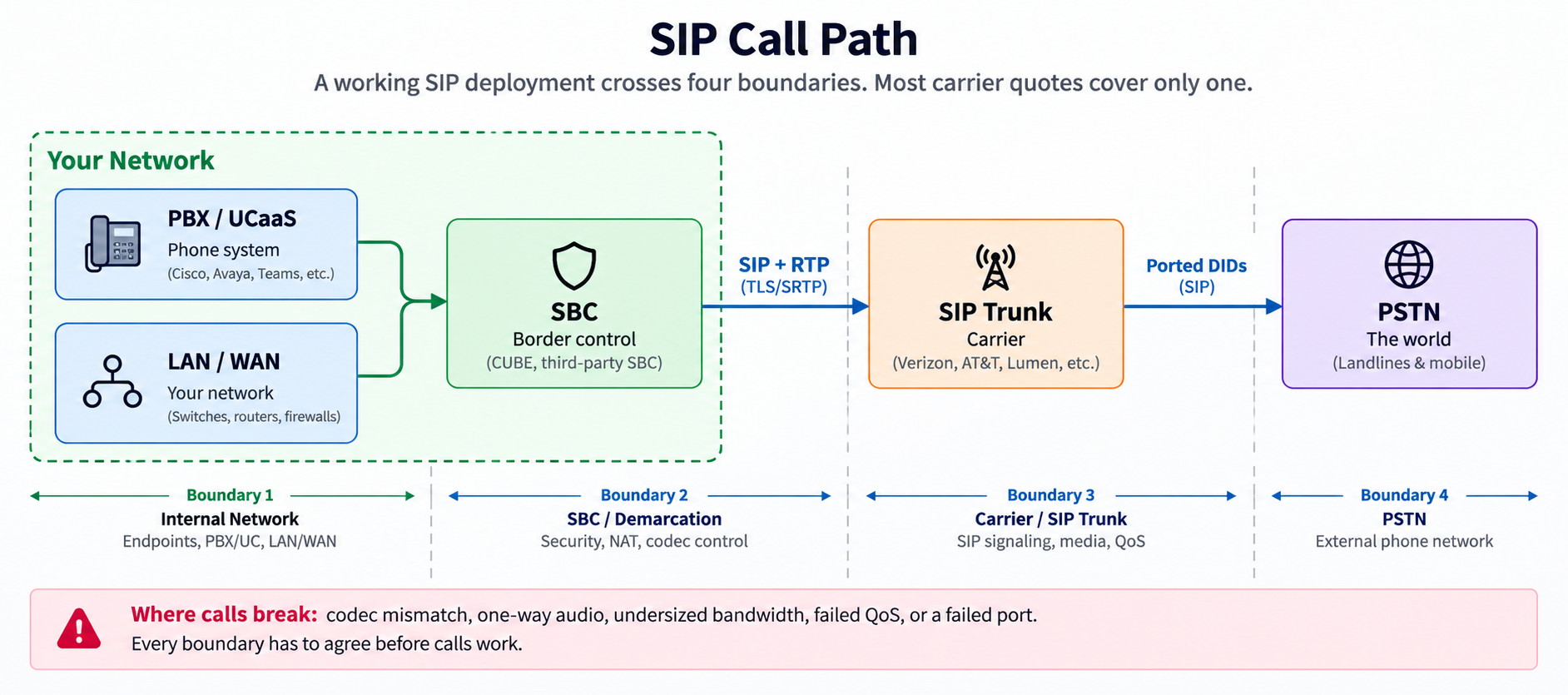
Carriers sell a circuit and leave the hard part to you—the session border controller, bandwidth, QoS, porting, and cutover. We do that part, then find the carrier that fits.
Engineering beyond the circuit
A carrier’s job ends when the circuit lights up. Ours ends when calls are clean, the old system is off, and your team can operate the new environment.
Start with the situation
Most voice decisions start with one of four situations. We’ll help define the realistic options, including the option to stay where you are.
Your carrier is charging legacy prices and the hardware may be out of support. Moving to SIP can make sense—but only when the PBX, SBC, and network are ready.
This is the time to review rates, redundancy, porting risk, and architecture before an auto-renewal takes away your leverage.
The platform is only one decision. Direct Routing, session border controllers, emergency calling, and number migration need their own plan.
Amazon Connect and CCaaS platforms have different economics and integration requirements. The right path depends on your agents, workflows, and call flows.
A complete voice strategy
Carrier sourcing is only one part of the job. The harder part is making the environment work reliably before, during, and after migration.
Requirements, multi-carrier quoting, rate comparison, contract review, and order management through installation.
Readiness assessment, voice network design, SBC build, QoS policy, testing, and cutover execution.
Moves, adds, changes, call-quality investigation, and carrier escalation when your team needs experienced help.
Migration runbook
Every engagement follows an ordered sequence. You’ll know what is complete, what is at risk, and what comes next.
Current bills, circuit inventory, PBX or UC platform, DID count, concurrent call peaks, and contract dates.
Bandwidth headroom, WAN topology, firewall and NAT behavior, SBC requirements, and known risks.
Qualified provider options compared against your current environment, with the tradeoffs written down.
SBC configuration, trunk provisioning, dial plan, QoS policy, failover paths, and emergency calling.
LOAs, CSRs, migration sequencing, confirmed dates, and a rollback plan.
A scheduled window, acceptance tests, a bridge plan, and live engineering support.
Call-quality monitoring and resolution of issues discovered after production traffic begins.
Independent by design
siptrunks.net is an independent voice infrastructure practice. We design the technical environment first, then help compare the carriers, UCaaS platforms, Teams voice options, or contact-center systems that fit it.
That means looking across the carrier, LAN/WAN, firewall, PBX, SBC, endpoint, emergency-calling, security, and application layers—not treating each one as somebody else’s problem.
Talk to an engineer
The more context you share, the more useful the first conversation can be. You don’t need a finished RFP—start with what is changing.